People are spending more time outside during the pandemic. That fact has been clear for a while now, and the reasons are intuitive.
While recreating, or relaxing, outside is not risk free, the contrast in infection risk level between outdoor and indoor activity is probably clearer than ever. As early as April 1 (no fooling!), NPR cited a public health expert’s judgment that socially-distanced bicycling, walking, and hiking, helped by wind and UV radiation, carried an “extremely low” risk of infection, barring getting directly coughed on or something like that. And the recent spikes in COVID cases, especially in some states in the South and West, are causing a reckoning among governors and mayors about hasty decisions to reopen restaurants, bars, and other indoor gathering spaces. Such locales seem to be ideal venues for virus spread.
So, how much more do we cherish trails these days? Unfortunately, too many people lack convenient access to a trail, and we have to keep aware of how that embeds in the larger picture of environmental injustice that needs to be addressed. For those who can conveniently access them, trails grant exercise, social distancing, and communion with nature and neighborhood — all while allowing another kind of health-related distancing: staying away from fast-moving cars. After all, we might have forgotten that we still have a traffic safety epidemic in this country.
With that in mind, let’s highlight two states in the region for evidence of increased usage of shared use paths, talk about the surge in bike sales, and then conclude with some national context.
Connecticut
Data from the Connecticut Trail Census COVID-19 Trail Impact Report: April-May 2020 (PDF)
Fortunately, a lot of data tracking and aggregation in the Constitution State is being done by the Connecticut Trail Census, a volunteer trail data partnership led by UConn. This report covers 12 infrared counters installed on shared use paths across the state. Unless otherwise noted, changes refer to year-over-year (YOY) differences between April-May 2019 and April-May 2020.
- Sum all 12 locations: +51% YOY
- Hop River Trail (Bolton): +170% YOY. The March 2019-March 2020 YOY increase was even larger: +216%, a margin of more than 6,000 monthly users. These March numbers were reported in the Hartford Courant on April 28, 2020.
- Norwalk River Valley Trail (Wilton): +130% YOY
- Air Line Trail (East Hampton): +110% YOY
- Farmington Canal Heritage Trail (Hamden): +110% YOY
- Derby Greenway (Naugatuck River Greenway) (Derby): -13%
- Riverfront Recapture Trails (Hartford and East Hartford — on either side of the Connecticut River): +95% and +69% YOY, respectively
- Farmington Canal Heritage Trail (New Haven): +35% YOY
- CTfastrak Bikeway (New Britain): -23% YOY in April, +1% YOY in May
The report surmised that the dip in the Derby Greenway may be that it is an already densely-packed trail (with raw counts much higher than any other census location), so social distancing considerations may have deterred people from using it. The latter three bullet points cover more commuter-oriented locations, which may explain why, with so much telecommuting this spring, they show less drastic increases. Still even a one-quarter or a one-third increase in one year is impressive.
Massachusetts
Data from the MassTrails Bicycle/Pedestrian Counts Pilot Program
The program, with data viewable on this dashboard, includes continuous bike-ped counts on four shared use paths: the Minuteman Bikeway in Arlington, the Northern Strand Community Trail in Malden, the Norwottuck Rail Trail in Hadley, and the Cape Cod Rail Trail.
A few caveats. First, the program started on June 10, 2019, so we can’t compare YOY data for the first few months of the pandemic. Second, the first couple of weeks only have the Norwottuck data. Third, data for only three counters (Norwottuck, Minuteman, and Northern Strand) are available on the dashboard until about mid-May 2020. Fourth, and related to the last caveat, I’m not sure about the status of data for the Cape Cod Rail Trail counter. It doesn’t show up as a point on the map somewhere on the Cape, but there is a counter called “MOBILE Test” that the map locates in the Gulf of Guinea off the coast of Gabon and west of Sao Tome and Principe. (It later showed up in Mobile, Alabama — go figure.) I don’t think that’s the CCRT counter. The data filter function doesn’t appear to be working — otherwise I’d remove “MOBILE Test” — but leaving it in shouldn’t be of consequence since MOBILE Test seems to have, at best, negligible count totals.
With all this in mind, what we can do is look at the year-over-year (2019-2020) difference in people bicycling + people walking for the 23 days from June 26 to July 18 for the Norwottuck, Minuteman, and Northern Strand counters. If the counters provided reliable data for each period, what we see is a huge spike in usage: there was an increase in 167% in 2020 compared to 2019! Overall, 288,936 users were counted for those days in 2020 compared to 108,405 in 2019.
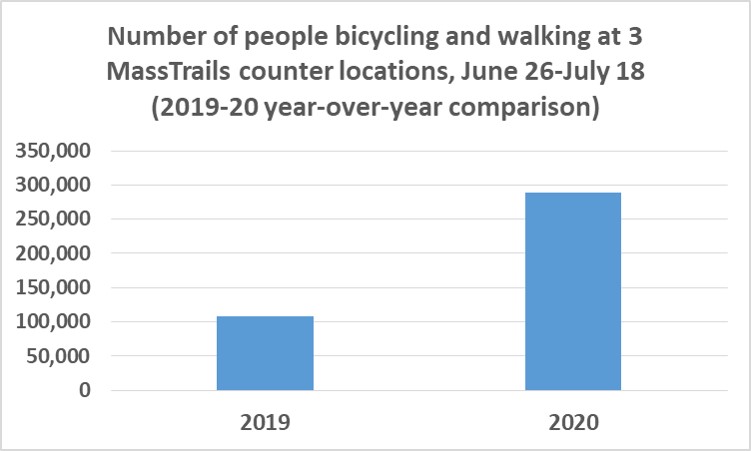
Looking at individual counters, the Minuteman counts show a 273% YOY increase, and the Northern Strand counts virtually doubled (97% YOY increase). The Norwottuck counter actually shows a 29% decrease. I wonder if that decrease reflects less usage by summer session college students and bike-commuting faculty (e.g. UMass-Amherst, Smith) with the pandemic keeping students away from campus.
The 2020 reference period does have the benefit of one more weekend day than the 2019 period, though that alone shouldn’t account for the major increase. Each period has one weekday that was a federal holiday (July 4 in 2019, July 3 in 2020). I wonder if the 2019 Minuteman data are complete, because it makes up only 58% of counts during the 2019 period but 81% of counts during the 2020 period.
All that said, these data indicate a significant increase in trail usage in Massachusetts.
More trail usage notes in the Bay State:
- The Daily Hampshire Gazette reported at the end of March some anecdotal evidence of the popularity of parks, open space, and trails in the Northampton area — including the Norwottuck Rail Trail. A week later, the Gazette published a longer article on bicycling in the Pioneer Valley, which included a section the pandemic’s effects on bike use. The article suggested that the warming weather, people’s desire for fresh air, and the ability to save money were spurring increased bike use, while the COVID-related decline in commuting, cancellation of bicycling encouragement events (e.g. Bike to Work Week), and delay in the deployment of ValleyBike Share for the season were countervailing forces.
Bike shops
In related news, highlights of how business is booming at New England bike shops:
- Spokehouse, a Black-owned bike shop in Upham’s Corner in Boston, has seen an increase in sales, reports Voice of America, as more and more people have come to see the importance of supporting Black-owned businesses in the wake of the Black Lives Matter protests. WBUR reported that when his store was looted the night before its planned reopening on June 1, owner Noah Hicks, instead of calling the police, used some crowdfunded donations to restart business while donating the rest “to support the movement against police brutality, including contributing to a bail fund for people who were arrested after the protest.”
- Central and Western Maine bike shops began to see “a surge in sales and tuneup appointments” during Maine’s stay-at-home order, reports the Lewiston Sun-Journal. The article quotes the owner of Lewiston’s Rainbow Bicycle stating that “his shop has been ‘one and a half times busier than the busiest we’ve ever been.’” Busytown Bikes, also in Lewiston, and Green Machine Bike Shop in Norway saw similar major spikes in sales.
- Randolph, VT-based The Gear House had almost sold out of its inventory by the end of May. Sales were so good that they couldn’t replenish their inventory fast enough (VTDigger, May 31, 2020)
- In late May, WMUR reported that the “general manager at Goodale’s Bike Shop in Nashua [NH] said on Monday that the past two months have been the busiest he has ever seen in this industry…Phone calls the month of March and April were up about 300%. Bicycles that usually would last through August are already gone.”
- Wicked Local Yarmouth reports on heavy demand at two bike shops near the Cape Cod Rail Trail: Cape Cod Sea Sports in Hyannis and Dennis Cycle Center in South Dennis, which is located directly on the CCRT.
National context
- Early in the pandemic, the Rails-to-Trails Conservancy (RTC) was tracking the initial uptick in trail use: “Dramatic increases in visitation are being recorded across the United States; an analysis of 31 trail counters for the week of March 16–22 by [RTC] found a nationwide trail usage increase of nearly 200% from that same week in 2019.”
- USA Today reports on the national acceleration in bike sales: “According to NPD Group, a data firm that analyzes consumer trends, sales of bikes, helmets and other accessories reached $1 billion in April, nearly double the typical $550 million to $575 million.” The New York Times had previously reported on a dramatic March YOY increase in bike sales reported by the same firm (NPD Group), resulting in bike shops being sold out and “a severe bicycle shortage” across the globe.
To close with an optimistic thought, the USA Today article quotes League of American Bicyclists Executive Director Bill Nesper, who suggests that the current increase in bicycling’s popularity may be permanent:
Nesper said a bicycle boom took place in the 1970s during that decade’s energy crisis. It didn’t stick. This time could be different, Nesper said. ‘We keep hearing from people that they’re rediscovering their communities in a new way,’ he said. “People are saying, ‘We like this.’ “
 Jeff Brubaker