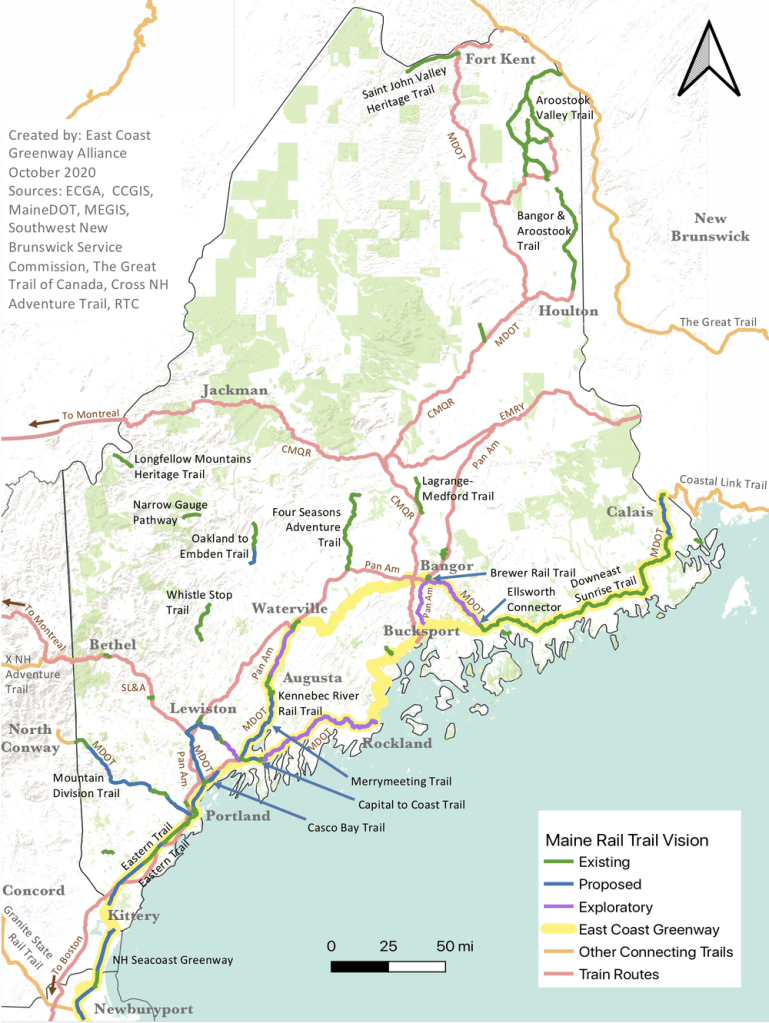
The Maine Trails Coalition has released the Maine Rail-Trail Plan, the coalition’s 250-mile trail vision for connecting communities across the state.
The 250 miles comes from 13 projects the coalition would like to see built over the next decade (2020-30) and 5 longer-term projects. These trails would not be isolated: “Each of these projects connects with, extends, and regionalizes existing multi-use trail infrastructure.”
The idea is to build these trails while maintaining the possibility for future rail service. This is primarily a reference to the abandoned rail corridor between Brunswick and Augusta, historically the “Lower Road” of the Maine Central Railroad. The last passenger train ran in 1960, and the last through train ran in 1986. The corridor is now owned by the state and managed by MaineDOT. Rail advocates and trail advocates have jostled over its future. The former would like to see an extension of passenger rail service to Augusta and Bangor, from Brunswick, currently the last stop of the Amtrak Downeaster. The latter see the corridor filling a critical gap that currently exists in the Capital-to-Coast trail vision and inland prong of the East Coast Greenway. This would be accomplished with the proposed 26-mile Merrymeeting Trail, which would connect the existing Kennebec River Rail Trail (KRRT) at Gardiner with the Androscoggin River Bicycle and Pedestrian Path in Brunswick. Nor would the Rail-Trail Plan interfere with a future train route to Montreal. The plan offers an olive branch: “The most important inter-urban corridors do not require a choice between trains and trails. There are alternate routes that allow both.” And it includes a map that overlays both future trail and future train routes.
If there is an “organizing principle” of the plan, it’s building out the East Coast Greenway. Maine is the apex of the 2,800-mile route, the destination state for northbound trippers. The state would host 367 “spine route” miles of the greenway, though only 125 off-road miles are currently built. About half are from the Downeast Sunrise Trail (DEST), and about 14 more are from the existing sections of the Eastern Trail.
A small gap to fill is extending the DEST the last ~15 miles from Ayers Junction all the way to the Greenway’s northern point at Calais. A medium-sized gap to fill is from Kittery to Kennebunk on the Eastern Trail. This is a key goal of the Eastern Trail Alliance.
The larger gap to fill is from Portland all the way to Ellsworth. The inland route, which is the East Coast Greenway’s “primary” route, has some small sections complete, such as the KRRT. It also benefits from a specific, studied proposal for filling a significant gap, i.e. the Merrymeeting Trail. The coastal route also has a few sections complete, like the Androscoggin River Bike-Ped Path in Brunswick. That path will hopefully be extended soon to Bath, an idea that’s been in the works at least since the existing path’s opening in 1998. (It was the subject of a 2004 feasibility study [PDF].) However, much legwork remains for identifying preferred routes, designing, and building gap-filling sections along both the inland and coastal routes.

 Jeff Brubaker